
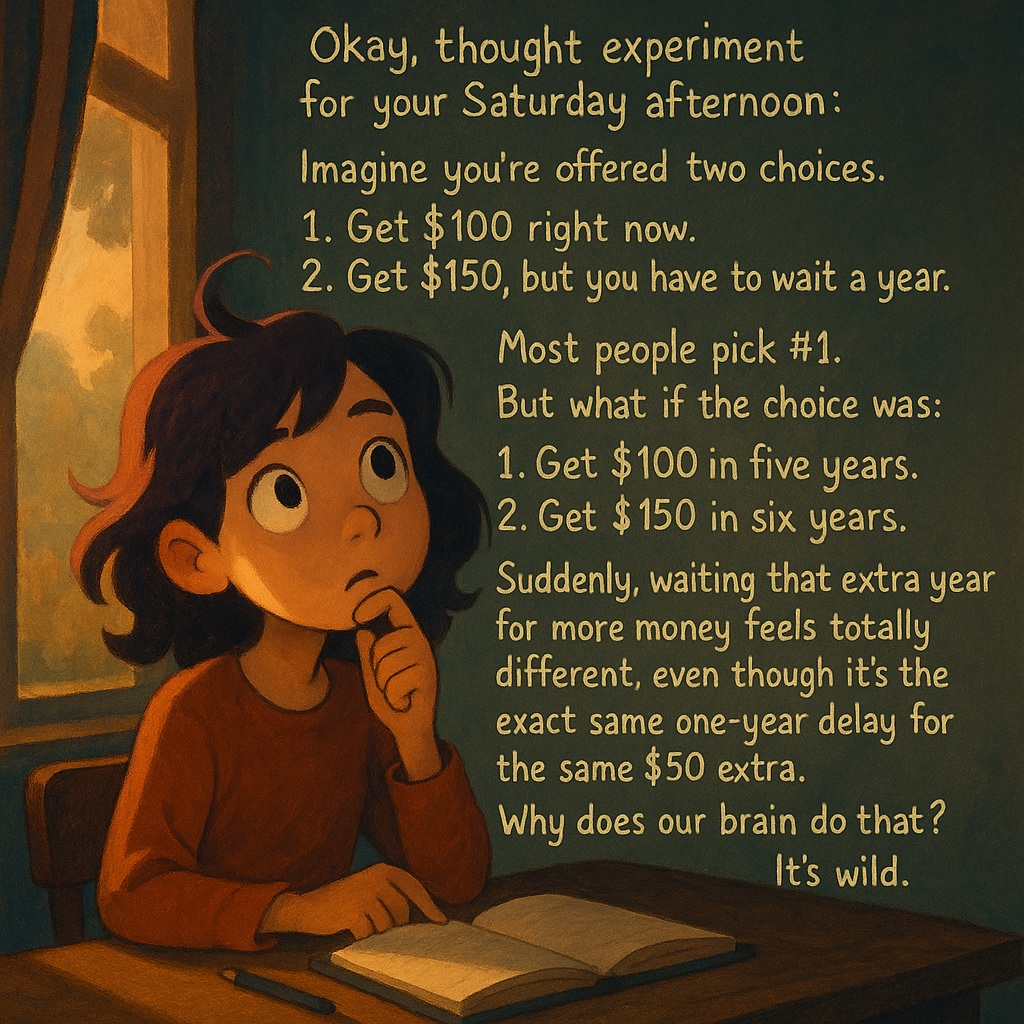
Okay, thought experiment for your Saturday afternoon:
Imagine you're offered two choices.
1. Get $100 right now.
2. Get $150, but you have to wait a year.
Most people pick #1. But what if the choice was:
1. Get $100 in five years.
2. Get $150 in six years.
Suddenly, waiting that extra year for more money feels totally different, even though it's the exact same one-year delay for the same $50 extra. Why does our brain do that? It's wild.
Imagine you're offered two choices.
1. Get $100 right now.
2. Get $150, but you have to wait a year.
Most people pick #1. But what if the choice was:
1. Get $100 in five years.
2. Get $150 in six years.
Suddenly, waiting that extra year for more money feels totally different, even though it's the exact same one-year delay for the same $50 extra. Why does our brain do that? It's wild.
Okay, thought experiment for your Saturday afternoon:
Imagine you're offered two choices.
1. Get $100 right now.
2. Get $150, but you have to wait a year.
Most people pick #1. But what if the choice was:
1. Get $100 in five years.
2. Get $150 in six years.
Suddenly, waiting that extra year for more money feels totally different, even though it's the exact same one-year delay for the same $50 extra. Why does our brain do that? It's wild.

 English
 Arabic
 French
 Spanish
 Portuguese
 Deutsch
 Turkish
 Dutch
Dutch
 Italiano
 Russian
 Romaian
 Portuguese (Brazil)